Franciscan Fractal
Contemplating Today’s Culture through the Eyes of St. Francis & the Life of Christ
“Advent’s Passion”
They shall name him “Emmanuel,”
which means, “God is with us.” Matthew 1:23
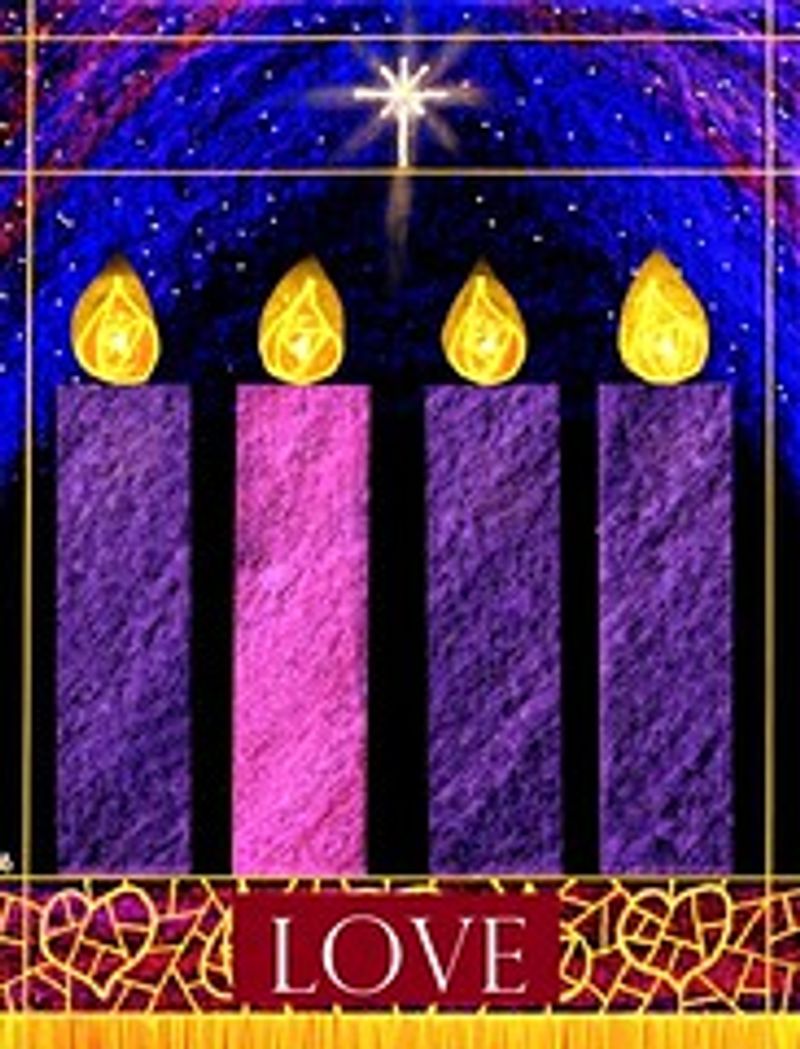
The fourth candle of the Advent wreath is called “Love.” It is also often referred to as the “Angels’ Candle,” symbolizing the angels' message of "Peace on Earth" to the shepherds. This announcement of the birth of Jesus celebrates the Good News of “God’s Love” for everyone, and is a breakthrough for all of humankind. This is a real, physical manifestation of God in human form (i.e., the Incarnation).
Isaiah prophesied centuries before Jesus’ birth that a child would be born who would be called Emmanuel, or Immanuel1, meaning “God with us.” The birth of Jesus fulfilled that prophesy. Prior to this event, God was often seen by Israel as a judgmental being who required obedience and punishment, if laws and regulations were not followed. In the birth of Jesus Christ, a “God distant from us” became a close, intimate “God with us.”
God thus becomes human and lives with us. The Incarnation eventually teaches us that God is also in us (if we pay attention). We finally are able to see what has always been true and so clearly articulated by St. Francis – spirit and matter are one.
Jesus’ birth also challenges us to question the very nature of God, which is love itself. This outpouring of God’s love changes us. What was revealed is that we now no longer need to live from our own preconceived misconceptions about the world, but from a new divine source of wisdom called “God’s Love.” This love always creates a path through the “spiritual darkness” in our minds.
God’s love is different from romantic, brotherly, or familial types of love. It is far stronger and is called “agape.” Agape is an unconditional, selfless, and sacrificial love that extends to all people, including people we judge to be unlovable. Perfect love is the willingness to sacrifice personal desires — even life itself — for those who may not be lovable. In the crucifixion, Jesus showed us how this perfect love works in human form.
Our work in this season is an opportunity to embrace intimacy with God. That happens when we become fully immersed in God’s love, instead of being distracted by superficial power, monetary success, status, and illusions of control. The birth of Jesus is a real directive for us to become God’s love. Contemplation is nothing other than an intimate, peaceful, loving inflow of God’s love.
St, Francis gave us an example of embracing this intimacy with God by re-envisioning Christmas itself. Instead of focusing on Easter as the most highly regarded feast day of the church year, St. Francis saw no reason for us to wait for God’s love shown in the cross and resurrection. He believed that God’s love has been there for us right from the beginning of creation.
In so doing, St. Francis provided an answer to a theological problem. If God had become flesh and taken on human form, then the problem of our “unworthiness” before God was already solved. God has “saved” us from the beginning and showed that by becoming one of us.
In his exuberance, St. Francis created the first manger scene in a cave using a live ox and donkey. St. Francis shifted his focus from fasting to feasting. When asked by a brother if it was allowable to eat meat on Christmas when it fell on a Friday, he said, “On Christmas Day, I want even the walls to eat meat!”2 St. Francis also proclaimed that every Christmas tree should be decorated with lights, so that its magnificence could show its true light. Thus, the tradition began.
When we think of Advent as a time of waiting and getting ready for Christmas, it is not about waiting for the little baby Jesus to be born. That already happened two thousand years ago. Rather, we are welcoming the Christ who has been present since the beginning of time. This eternal Christ is forever being born into the soul of every human being.3 How amazing and wonderful!
Prayers and Advent Blessings,
Fr. John
1There's no real difference in meaning between the two words, only in spelling and origin. Immanuel (with an “I”) is the direct Hebrew transliteration of the original prophetic name meaning "God with us," while Emmanuel (with an “E”) comes from the Greek Septuagint (Greek Old Testament) translation, which used “E” for the Hebrew sound, making it a translation of a translation. Both refer to the same concept of God's presence, prophesied in Isaiah and applied to Jesus in the New Testament.
2Thomas of Celano, The Remembrance of the Desire of a Soul, chapter 151. See Francis of Assisi: Early Documents, vol. 2, The Founder, ed. Regis J. Armstong, J. Wayne Hellman, William J. Short (New City Press: 2000), 374.
3https://cac.org/daily-meditations/what-are-we-waiting-for-2021-12-19